The Clip Station: an amazing tool for building a calmer dog
What is a Clip Station?
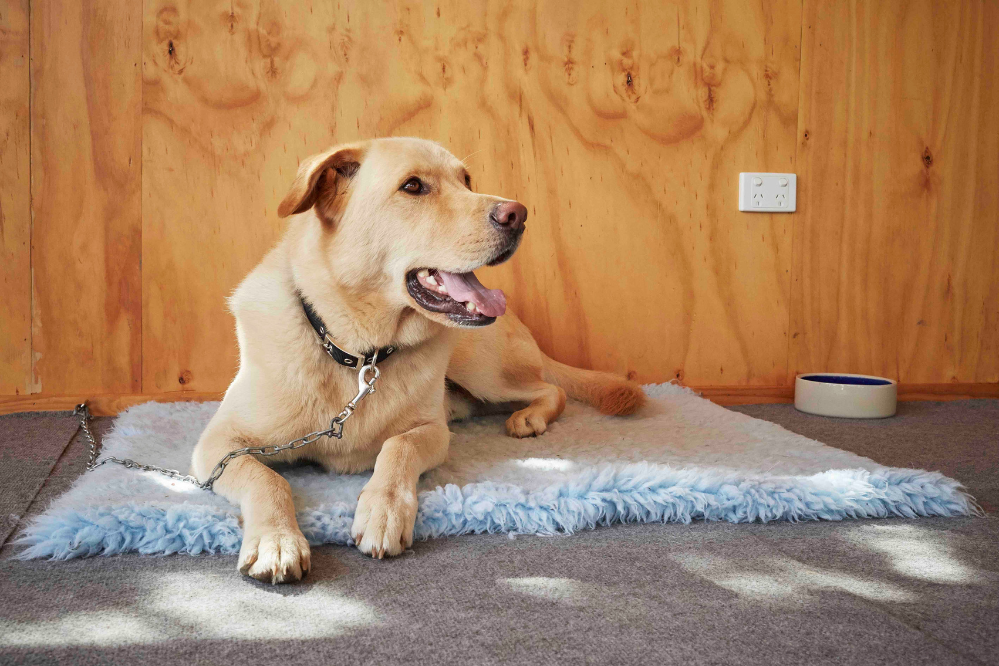
A clip station is one of the simplest tools in your training kit, and one of the most powerful. At its core, it's just a short lead — ideally a light chain — clipped to a fixed point with a comfortable mat or bed placed right beside it.
But don't let the simplicity fool you. This tool helps build calm behaviour in your pup and can assist with a plethora of behavioural challenges.
Here is why it’s important:
The clip station earns its place in your home for a whole list of reasons.
Settling. The most important benefit is that it helps teach your pup how to settle down calmly. This is an invaluable life skill.
Safety and containment. It's a controlled, quiet, den-like space — more freedom than the crate, but still with boundaries.
Physical control for training. It lets you settle your pup and run focused training sessions without them wandering off mid-lesson.
House training support. Dogs generally won't soil where they rest (unless truly desperate), so the clip station — used alongside the crate — is a great house training aid.
Teaching separation. You can leave your pup clipped up for periods while you get on with things around the house — ideally within hearing range at first. It teaches your pup to settle while you come and go rather than following you everywhere.
Limits destructive behaviour. A secured pup can't get into mischief.
Portable calm, anywhere. Loop a lead around a café table leg, a chair, the couch, or even your own leg (just make sure it's nothing your pup can drag away), and you've got an instant way to keep your pup contained and calm wherever you go.
A tool for time-out. Once well-established as a safe, positive place — give it at least a month — the clip station can also facilitate calm time-out when needed. Not a punishment, but an opportunity to settle.
Rehabilitation work. For fear, territorial behaviour, or visitor aggression, the clip station creates a safe barrier that lets your dog remain in the room rather than needing to avoid the situation altogether, which is a huge part of working through those issues.
Wolves and dogs naturally gravitate toward small, den-like spaces. Start early, and both the crate and the clip station become places your dog genuinely loves — a secure base they're happy to settle into, even when you're not right there with them.
How to build one:
Setting one up takes five minutes and barely any equipment:
Choose your locations. Aim for two or three clip stations around the house, all in social areas — your dog wants to be near the action, near you. I like to have one near the kitchen, by the couch in the lounge, in an outdoor seating area, and in the office if you work from home.
Anchor a clip point. Secure an eyelet screw into the wall's baseplate where possible. If you can’t screw into walls, just loop the lead around a heavy, immovable piece of furniture or a pole.
Attach the chain. Run a length of light chain from the wall clip to a dog clip at the other end. Keep it to your dog's own body length — roughly 0.5 to 1 metre, no more. Chain is preferable as your dog can’t chew through it, but a normal short lead can be used while out and about (looped around furniture or a pole), just ensure your pup isn’t chewing it.
Add a mat or bed. Make it somewhere genuinely appealing to lie down.
Once it's set up, it becomes one of the most-used tools in your kit — from five-minute sessions to a few hours, depending on what you're working on that day.
The materials can be purchased from hardware stores.
Introducing your pup or dog to the Clip Station
This step deserves patience. Rush it, and you risk your pup getting a fright and forming a bad association with a place that's meant to be their safe zone.
For a pup, start this around 10 weeks of age — but only once they're already comfortable with resistance on the lead. If your pup is on the sensitive side, or isn't yet used to lead pressure, hold off until 12 weeks.
Here's the process:
Start with a long line. Run it through the wall hook or around the furniture leg so you can adjust the level of resistance to begin with. This is particularly important for sensitive pups, so you can control the pressure according to how they’re reacting. See image below.
Clip your pup to the long line.
Lure them onto the mat. Drop food onto it, click and reward for stepping on and staying there.
Run through basic commands using a clicker and high value food rewards, to keep them in a calm Learning State and on the mat. Some pups and dogs settle more quickly with hand signals only, no verbal cues. Toss the food between their feet rather than handing it to them, to encourage them to stay down and settled.
Work towards a Zen Down. This is your goal position as it activates the vagus nerve — calm, settled, and relaxed.
Gradually shorten the line over successive sessions, until your pup can be comfortably contained on the mat by the short chain.
Go at your pup's pace. Watch for signs of panic at the restraint and slow down by releasing some of the pressure on the long line if needed — this is not a step to force.
Practise once or twice a day, slowly building duration. At first, just take a few steps back, then return to click and reward. Then a bit further, for a bit longer, each time.
Keep the spot attractive. When you start stepping away for longer stretches, leave a toy or long-lasting treat.
Build up absence gradually over the following week or two. Go about your day, returning to click and reward calm, quiet behaviour — never reward barking or attention-seeking.
A nice time to build duration is while you’re watching TV: your pup can settle down right beside your legs, so they have that reassuring physical contact while they get used to the restraint of the clip station.
Here I use a long lead looped around a couch to begin with a young puppy
Beyond training sessions
Use your clip station often. Three or four scattered through the main social areas of your home means there's always a calm, familiar spot on hand.
It's also one of the best tools going for building a well-mannered café dog or visiting friends’ homes— loop the lead around your leg or a chair, practise Sit and Zen Down with click and reward, and you've got a dog who can settle anywhere, not just at home.
Done consistently, the clip station becomes somewhere they love — a spot they calmly settle into on their own.