Why is my cat attacking me?
Understanding and resolving human-directed aggression


Understanding and resolving human-directed aggression
March 16, 2026
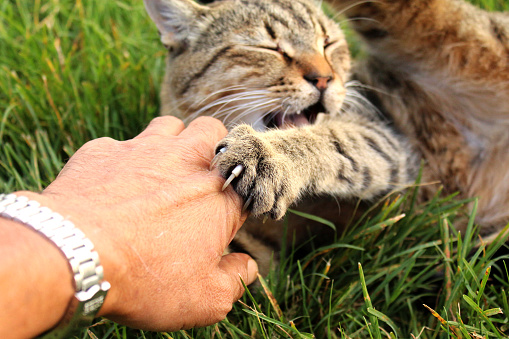
Being scratched or bitten by your own cat is both unsettling and painful! If you're living with an aggressive cat, you're not alone, and you're not without options. Human-directed aggression is one of the most common behavioural issues cat owners face, and while it can feel baffling or even personal, it almost always has a clear cause. Understanding that cause is the first and most important step toward resolving it.
This guide walks you through the main triggers behind feline aggression toward people, and the evidence-based techniques you can use to address it safely and effectively.
Before diving into causes and solutions, it helps to know what early aggression looks like in cats. Many owners only notice aggression when it's already at its peak — the bite or the swipe. But cats almost always signal their discomfort before reaching that point.
Watch for dilated pupils, ears pinned flat or rotated backward, a lowered body posture, a tail tucked under the body, or a tail that flicks sharply from side to side. These are your cues to back off, give your cat space, and reassess what's triggering the response. The sooner you learn to read these signals, the better you'll be at preventing escalation.
There is no single explanation for why cats become aggressive toward people. The triggers are varied, and identifying the right one for your cat is essential — because the solution depends entirely on the cause.
Cats have a critical developmental window, roughly between two and seven weeks of age, during which they learn to feel safe around humans. Cats who miss out on positive human contact during this period often grow up fearful of people. They may bond closely with one trusted person but react with fear or aggression toward everyone else. Cats who received no human contact at all during this window are likely to remain essentially feral — deeply fearful of people and extremely difficult to socialise later in life.
This is one of the most common forms of aggression seen in domestic cats. It occurs when a cat feels threatened and perceives no safe escape route. The trigger might be an unfamiliar person entering the home, a sudden movement, a loud noise, or even an unfamiliar smell. Fear-induced aggression can be defensive (the cat is trying to make the threat go away) or offensive (the cat strikes pre-emptively), though defensive responses are far more typical.
Some cats direct aggression toward people as a way of asserting dominance or status. This is most often noticed during handling or play, and it may also manifest as blocking doorways, guarding resources, or threatening other animals in the household. It's worth noting that cats do not have a linear dominance hierarchy the way dogs do — asserting dominance over a cat typically backfires and provokes a defensive threat rather than submission.
Cats have an arousal threshold, and when that threshold is exceeded during play or petting, aggression can follow. Over-stimulation triggers something akin to prey drive — the cat's brain switches into hunting mode, and biting or scratching can result. This is particularly common in indoor-only cats who lack sufficient physical and mental stimulation, and in cats that were orphaned or weaned too early and never learned appropriate play behaviour from their mother or littermates.
When a cat feels threatened but cannot escape or confront the actual source of its fear, it may redirect that aggression onto whatever — or whoever — is nearby. A cat who spots a strange cat through the window, for example, may turn and attack its owner. This type of aggression can appear sudden and severe, but there are usually warning signs: dilated pupils, piloerection (fur standing up), and a tail flicking toward the person or animal about to be struck.
A cat in pain — or one anticipating pain — can become aggressive when touched or handled. This is the most common form of aggression seen in veterinary settings, where cats associate handling with previous discomfort. At home, it often arises when applying ear drops, eye drops, or other medications. Chronic conditions such as arthritis, dental disease, and ear problems can make cats reactive when sensitive areas are touched. If your cat has recently become aggressive without an obvious behavioural cause, a veterinary check to rule out pain is essential before attempting any behaviour modification.
It's also important to note that punishment can itself cause pain-induced aggression. Physical or assertive responses toward a cat — even those intended to signal displeasure — are likely to provoke a defensive counter-threat. Punishment is never appropriate with cats and will worsen aggression over time.
Cats form negative associations quickly and generalise them broadly. A single bad experience can lead to lasting fear- or defence-based aggression not only in situations similar to the original event, but also toward people, animals, or environments associated with it. This negativity bias is a normal feline survival mechanism — but it makes trauma-induced aggression particularly tenacious to treat.
Moving home, the arrival of new pets, construction noise, fireworks, or any significant disruption to your cat's territory can trigger redirected or fear-based aggression. Cats are highly territorial animals, and instability in their environment can translate directly into instability in their behaviour.
Unspayed females may become more aggressive during oestrous due to hormonal fluctuations. Queens with kittens can exhibit strong maternal aggression driven by hormones such as prolactin, which increases protectiveness. If you're a breeder managing a queen with a new litter, keeping the environment calm and quiet and minimising visitor contact is essential.

Treatment falls into three broad categories: managing triggers, enriching your cat's environment, and modifying behaviour through training. In most cases, a combination of all three will be required.
The first step is identification. Once you understand the trigger, you can begin to manage it. For some triggers, simple avoidance is the most practical starting point — if your cat becomes aggressive when picked up, stop picking her up. If visitors trigger aggression, keep your cat in a separate room during social gatherings until you've made progress with desensitisation. Avoidance isn't a permanent solution, but it prevents the aggression from being rehearsed and reinforced while you work on the underlying issue.
Boredom and frustration are underappreciated contributors to feline aggression. A well-stimulated cat is a calmer cat. Create safe retreats — elevated perches, quiet rooms, and hiding spots like boxes or tunnels — where your cat can withdraw when feeling overwhelmed. Rotate toys regularly to sustain interest, and provide self-play options such as puzzle feeders, retrieve balls, and stuffed toys. Catnip can be incorporated into toys to help some cats settle.
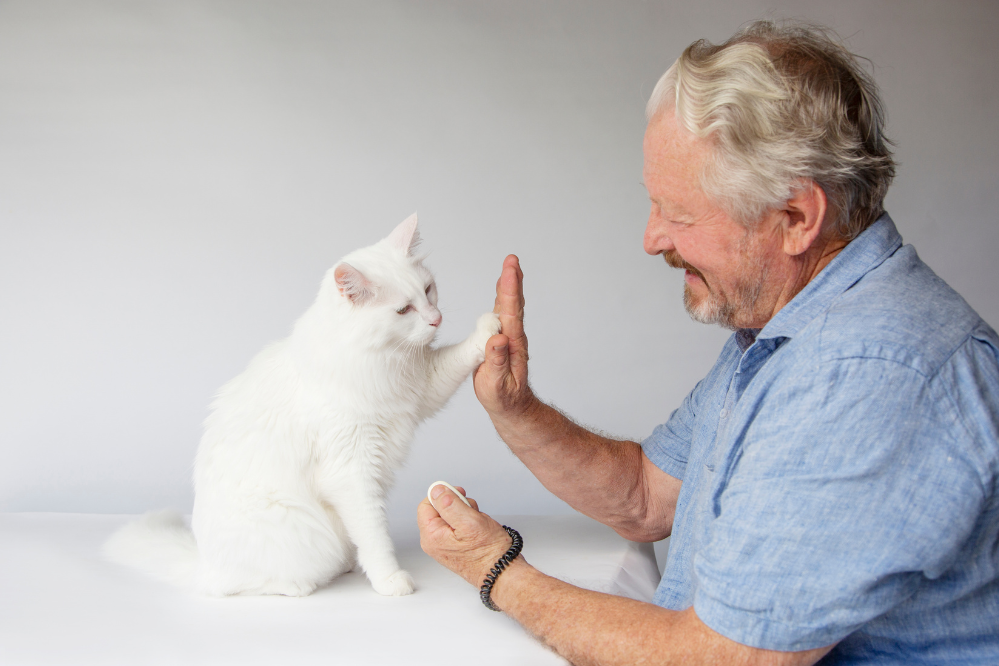
Training is also a powerful form of enrichment. It exercises your cat's brain, burns energy, strengthens your bond, and builds emotional resilience. Clicker training is particularly effective — it rewards calm, cooperative behaviours and gives your cat a constructive way to engage with you.
If your cat is particularly anxious, calming pheromone products may help reduce baseline fear and make behaviour modification more effective. In more severe cases, anti-anxiety medication prescribed by a vet can facilitate the process.
Redirect before it escalates. As soon as you see the first signs of arousal or aggression, stop what you're doing and redirect your cat's attention to a toy — squeaky toys are particularly effective because they activate prey drive and quickly grab focus. If aggression occurs during play, stop the session immediately, allow your cat to settle, and leave the room if necessary.
Involve everyone in the household. If your cat has a particular aversion to one person, that person should become more actively involved in daily care — feeding, play, and training. Building a positive association is the most direct path to reducing aggression.
Desensitise to body handling. Use a clicker and high-value food rewards to mark and reinforce calm behaviour during handling. Begin in areas your cat tolerates and progress slowly toward more sensitive zones, following your cat's cues about pace. Always end sessions before your cat reaches frustration — finishing on a positive note is critical.
Teach your cat to distinguish toy from hand. Use interactive toys — flirt poles, balls, small squeaky toys — that keep your hand at a distance during play. Gradually work closer as your cat's self-control improves. Never engage in rough and tumble play with hands, feet, or clothing; this teaches your cat that body parts are legitimate targets.
Socialise to visitors gradually. For cats fearful of strangers, start with people your cat already knows and slowly introduce less familiar faces. Crate or harness training beforehand gives you a safe way to manage your cat's exposure. Ask visitors to participate in the training — rewarding calm behaviour and progressing to closer contact only when your cat is ready.
The techniques above are effective for many cases of mild to moderate aggression. However, if biting is happening frequently or severely, or if you feel unsafe around your cat, it's time to involve a qualified animal behaviourist. Do not put yourself, family members, or visitors at risk. Serious aggression warrants professional assessment, and in some cases veterinary intervention — including pain management or medication — may be a necessary part of the treatment plan.
Book a Virtual Consultation with me to discuss your cat’s behaviour here.
Human-directed aggression in cats is rarely random and almost never hopeless. It is a communication — your cat telling you, in the only language available to her, that something in her world feels threatening, painful, or overwhelming. With patience, the right techniques, and a willingness to see things from your cat's perspective, most cases can be meaningfully improved. Understanding your cat is the foundation of everything else.
Sign up to our newsletter for free tips and dog training advice that will transform your relationship with your dog.